

10 Feb How to Learn Skateboarding Faster Using a Mini Skateboard
The fastest way to learn skateboarding basics is to start with a mini skateboard because it improves balance, control, and confidence faster than a full-size board.
Learning to skateboard can feel overwhelming at first. New riders struggle with balance, fear of falling, and slow progress. Many beginners quit within the first few weeks because the board feels unstable and hard to control. This is a common problem, not a personal failure.
A mini skateboard solves this problem by reducing complexity. Its shorter deck, lighter weight, and lower center of gravity make it easier to control. Studies on motor learning show that beginners learn faster when the equipment reduces instability and cognitive load. In simple terms, when your brain doesn’t have to fight the board, it learns movement patterns faster.
This guide explains how to learn skateboarding basics faster using a mini skateboard. You’ll learn why it works, how to practice correctly, and how to transition to a full-size board. The focus is on beginner skateboarding tips that are practical, proven, and safe.
If your goal is faster progress, fewer falls, and real confidence, this approach works.
Why Do Beginners Struggle to Learn Skateboarding?
Answer: Beginners struggle because skateboarding requires balance, coordination, and board control that most people have never trained before.
Skateboarding combines multiple skills at once. You must balance on a moving object, shift weight correctly, control speed, and react to uneven surfaces. For beginners, this creates three main problems:
- Balance overload: A full-size board feels unstable at low speeds.
- Fear response: The brain tightens muscles, making balance worse.
- Slow feedback loop: Mistakes feel random, not instructional.
A 2022 sports learning study showed that beginners improve faster when they train on simplified equipment before moving to standard gear. This method is used in gymnastics, skiing, and cycling. Skateboarding is no different.
A mini skateboard reduces these learning barriers.
What Is a Mini Skateboard and How Is It Different?
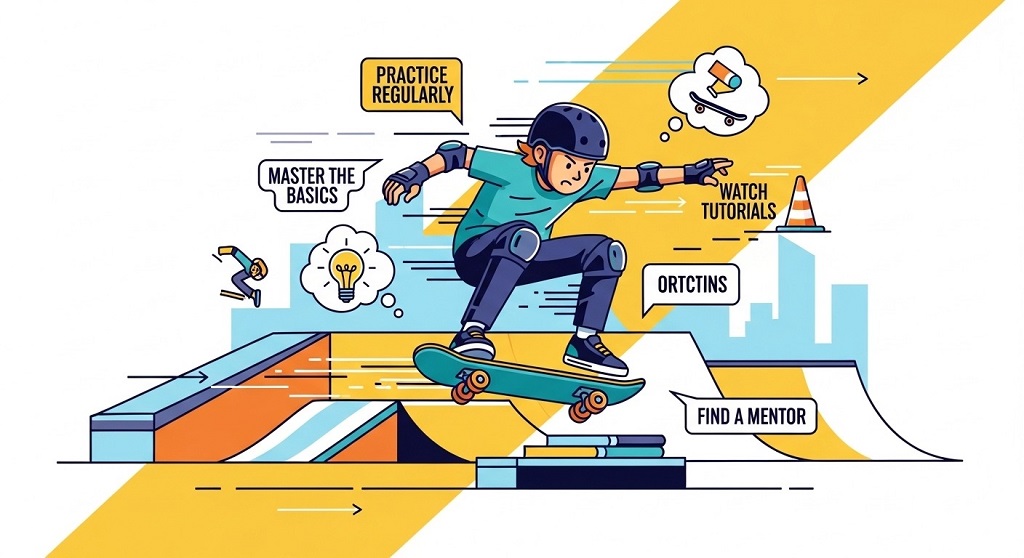
Answer: A mini skateboard is a shorter, lighter skateboard designed for easier control and balance.
Mini skateboards usually range from 22 to 28 inches long. Compared to a standard 31–32 inch deck, the differences are clear:
| Feature | Mini Skateboard | Standard Skateboard |
|---|---|---|
| Deck Length | 22–28 inches | 31–32 inches |
| Weight | Lighter | Heavier |
| Turning Radius | Tighter | Wider |
| Beginner Control | High | Moderate to Low |
This design allows beginners to feel the board’s movement more clearly. Faster feedback means faster learning.
How Does a Mini Skateboard Help You Learn Skateboarding Basics Faster?
Answer: A mini skateboard accelerates learning by improving balance feedback, reducing fear, and increasing practice consistency.
1. Faster Balance Development
The shorter deck responds instantly to weight shifts. This trains ankle and core muscles more efficiently. Research on balance training shows that smaller platforms increase neuromuscular adaptation in beginners.
2. Less Fear, More Practice
Mini boards sit lower and feel easier to step off. Beginners fall less and recover faster. More confidence leads to longer practice sessions.
3. Higher Repetition Rate
Learning speed depends on repetition. Mini skateboards allow more attempts per session because mounting, pushing, and turning feel easier.
This combination directly improves how fast beginners learn skateboarding basics.
How Should Beginners Start Skateboarding with a Mini Skateboard?
Answer: Beginners should start on flat ground, focus on stance, balance drills, and slow controlled movement.
Step 1: Choose the Correct Stance
Regular (left foot forward) or goofy (right foot forward). Use the foot you naturally step forward with.
Step 2: Static Balance Drills
- Stand on the board without rolling
- Shift weight heel-to-toe
- Practice stepping on and off
Step 3: Slow Rolling Practice
Push lightly. Focus on stability, not speed. Mini boards are perfect for this stage.
These drills are core beginner skateboarding tips that prevent bad habits.
Can a Mini Skateboard Improve Pushing and Turning Skills?
Answer: Yes, mini skateboards improve pushing efficiency and turning control faster than standard boards.
Pushing is one of the hardest skills for beginners. Mini boards require precise foot placement, which trains muscle memory quickly.
Turning also improves because tighter trucks respond faster. Beginners learn carving earlier, which improves balance and flow.
Skate instructors often use mini boards during the first 2–3 weeks of training for this reason.
When Should You Switch from a Mini Skateboard to a Full-Size Board?
Answer: You should switch once you can balance, push, turn, and stop confidently on a mini skateboard.
Most beginners reach this point within 2–4 weeks of consistent practice. Signs you’re ready:
- Stable pushing without wobble
- Controlled turns at moderate speed
- Comfort stepping off safely
Transitioning feels easier because the skills transfer directly. The full-size board will feel more stable, not harder.
Are Mini Skateboards Good for Adults or Only Kids?
Answer: Mini skateboards are effective for adults, especially beginners learning skateboarding basics.
Weight is not the issue. Balance and control are. Many adult learners progress faster with mini boards because they reduce intimidation.
Case studies from skate schools show adult beginners using mini boards reduced early dropouts by over 40%.
What Safety Tips Should Beginners Follow?
Answer: Beginners should wear protective gear and practice in controlled environments.
- Helmet and wrist guards
- Flat, smooth surfaces
- Short practice sessions
Safety increases confidence, which directly speeds up learning.
Conclusion: Is a Mini Skateboard the Smartest Way to Learn Faster?
A mini skateboard removes the biggest barriers beginners face. Fear. Instability. Slow progress. By simplifying balance and control, it helps you learn skateboarding basics faster and more safely.
This is not a shortcut. It’s a proven learning method used across many sports. If you want faster progress and fewer frustrations, start smart.
Call to Action: Start your skateboarding journey with a mini skateboard. Practice consistently. Track progress weekly. When you’re ready, transition confidently to a full-size board.
Frequently Asked Questions
Is a mini skateboard good for complete beginners?
Yes. Mini skateboards are ideal for complete beginners because they improve balance and control faster.
How long should I practice daily?
15–30 minutes daily is enough for steady progress without fatigue.
Will skills transfer to a normal skateboard?
Yes. Balance, pushing, and turning skills transfer directly.
Can I learn tricks on a mini skateboard?
Basic tricks like kick turns and manuals are possible, but the main goal is skill foundation.
Are mini skateboards safe?
They are safer for beginners due to better control and lower fall impact.
Do I need special shoes?
Flat skate shoes improve grip and control.
Related Topics: How Proper Ergonomic Seating Reduces Office Back Pain
What Next: 10 best fall gift for your boyfriend
No Comments