

16 Sep How Much Money Can You Fit in a Duffel Bag?
Key Takeaways
- A large duffel bag can theoretically hold over 5 million dollars in 100-dollar bills.
- Weight, not space, becomes the real limit when filling a bag with cash.
- A single US bill weighs about one gram and measures 6.14 by 2.61 inches.
- Smaller bills dramatically reduce the total value a bag can carry.
- Transporting large amounts of cash has legal reporting requirements.
It started during a movie night with friends. We were watching a classic heist film, and the thieves grabbed duffel bags stuffed with cash. One friend laughed and said, “There is no way that much money fits in those bags.” That comment sparked a two-hour debate. Therefore, I decided to sit down, consult build-capacity specs from industry experts like https://luxuryprobags.com/, and actually do the math. The results surprised all of us.
The answer depends on several factors, including the bag size, the bill denomination, and how tightly you pack the money. Additionally, weight plays a huge role that most people never consider. According to the US Bureau of Engraving and Printing, every American bill weighs about one gram, regardless of its value. This small detail changes everything when you calculate totals. This guide breaks down the numbers step by step. You will learn how much cash fits in different duffel bag sizes and what limits apply.
The Size of a Standard Duffel Bag
Duffel bags come in several standard sizes, and each one holds a different amount of stuff. Manufacturers usually measure capacity in liters. A small carry-on duffel holds around 40 liters. A medium gym duffel holds roughly 60 liters. However, large travel duffels can reach 90 to 100 liters or more. Military-style duffels sometimes exceed 120 liters.
Let us convert these numbers into something useful. One liter equals about 61 cubic inches. Therefore, a 60-liter duffel offers roughly 3,660 cubic inches of space. A large 100-liter bag provides about 6,100 cubic inches. These numbers matter because cash stacks are surprisingly compact.
The shape of the bag also affects capacity. Duffel bags are cylindrical or rectangular with soft sides. Soft sides actually help because fabric stretches slightly around rigid cash stacks. Additionally, most duffels have zippers that expand the main compartment. Some bags also include side pockets, although these hold little cash.
My friend and I tested this with a 70-liter duffel and stacks of paper cut to bill size. We fit far more than either of us expected. The bag swallowed every stack we made and still had room to spare. Therefore, space is rarely the problem when filling a duffel with money. As you will see next, the real challenge comes from weight.
The Dimensions and Weight of US Currency
Every bill printed in the United States shares identical dimensions. According to the Federal Reserve and the Bureau of Engraving and Printing, a US bill measures 6.14 inches long and 2.61 inches wide. Additionally, each bill is about 0.0043 inches thick. This means a stack of 100 bills stands roughly 0.43 inches tall.
Weight is the other key number. A single US bill, no matter the denomination, weighs approximately one gram. Therefore, a stack of 100 bills weighs 100 grams, or about 0.22 pounds. A million dollars in 100-dollar bills contains 10,000 notes. That stack weighs about 22 pounds total.
Let us look at some quick reference numbers:
- A single bill: 6.14 by 2.61 inches, one gram
- A bundle of 100 bills: 0.43 inches thick, 100 grams
- One million dollars in 100s: 10,000 bills, about 22 pounds
- One million dollars in 20s: 50,000 bills, about 110 pounds
The denomination changes everything. A million dollars in 20-dollar bills fills five times more space than the same amount in 100s. It also weighs five times more. Therefore, movie scenes showing small bags of mixed bills holding millions are pure fiction.
I found this fact fascinating when I first calculated it. My friend assumed weight was irrelevant. However, once we stacked cut paper to simulate cash, the bag became heavy fast. The math proves that weight limits your haul before space does.
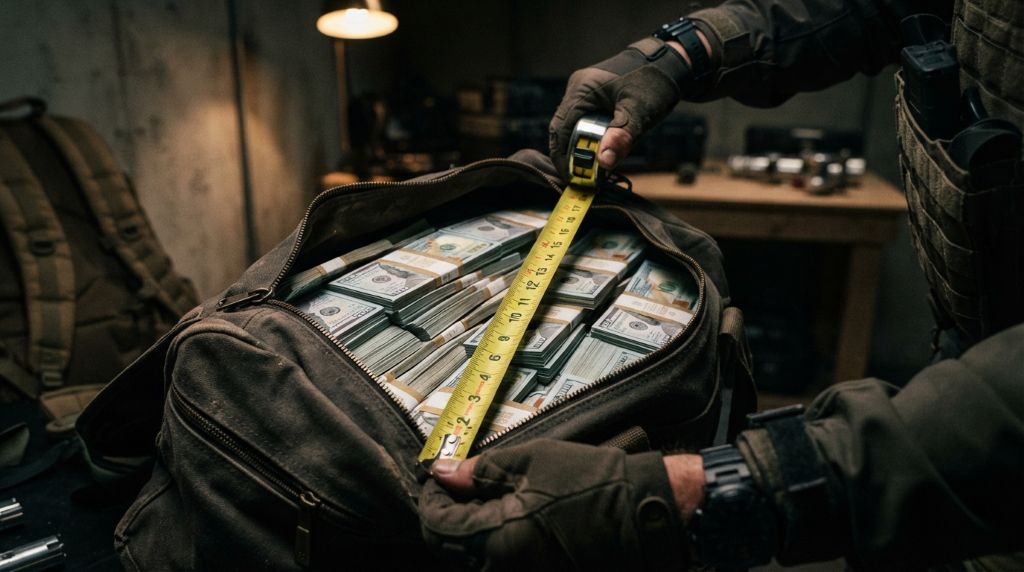
Doing the Math: How Much Cash Actually Fits
Now comes the fun part. Let us calculate how much money fits in a large 100-liter duffel bag using 100-dollar bills. The volume of a single bill equals 6.14 times 2.61 times 0.0043 inches. That works out to about 0.069 cubic inches per bill.
A 100-liter bag offers roughly 6,100 cubic inches of space. Divide that space by the volume of one bill. The theoretical answer is around 88,000 bills. In 100-dollar bills, that equals about 8.8 million dollars.
However, theory and reality differ. Perfect packing is impossible because stacks leave gaps. Bags have curved corners and uneven shapes. Additionally, you need space to close the zipper. A realistic packing efficiency sits around 60 to 70 percent. Therefore, a large duffel realistically holds about 55,000 to 60,000 bills. That translates to roughly 5.5 to 6 million dollars in 100-dollar bills.
Here is a quick breakdown by bag size:
- 40-liter carry-on duffel: about 2 to 2.5 million dollars
- 60-liter medium duffel: about 3 to 3.5 million dollars
- 100-liter large duffel: about 5 to 6 million dollars
These figures assume 100-dollar bills packed in tight stacks. Using 50-dollar bills cuts the totals in half. Using 20-dollar bills reduces them to one-fifth. My friends were shocked when I showed them these numbers. The movie villains were actually underselling their bags, at least in pure volume terms.
Weight Limits and Practical Reality
Space tells only half the story. Weight creates the real limit for anyone carrying a cash-filled duffel. Remember, each bill weighs one gram. Our realistic load of 60,000 bills weighs 60 kilograms, or about 132 pounds. That is far too heavy for most people to carry comfortably.
An average adult can lift and carry around 50 pounds without severe strain. Fifty pounds equals roughly 22,700 bills. In 100-dollar bills, that is about 2.2 million dollars. Therefore, a realistically portable duffel of cash holds closer to 2 million dollars, not 6 million.
Several practical factors reduce this number further:
- Cash straps and rubber bands add small amounts of weight and bulk
- Stacked money does not compress, so gaps remain unavoidable
- A fully packed duffel puts strain on zippers and straps
- One person cannot run or move quickly with 130 pounds
There is also the problem of bag strength. Standard duffels carry clothes and gear, not dense paper. Loading a cheap duffel with 100-plus pounds risks ripped straps and broken zippers. Military-grade bags handle the weight better, but they cost more.
When my friend and I simulated a full bag, we stopped at about 60 pounds of paper. Neither of us could lift it comfortably for more than a minute. That experiment proved the point better than any calculator. The movies make it look easy, but reality disagrees.
Real-World Rules and Legal Considerations
Carrying large amounts of cash is not illegal in the United States. However, the law requires reporting in certain situations. According to federal law, you must report cash transactions over 10,000 dollars to the Internal Revenue Service. Banks file Currency Transaction Reports for deposits above that amount. Additionally, border crossings require declaring amounts over 10,000 dollars.
Transporting millions in cash raises red flags. Law enforcement can seize cash under civil asset forfeiture laws if they suspect illegal activity. You do not need to be convicted of a crime to lose the money. Therefore, legitimate reasons for large cash transport usually involve bank transfers instead.
Real-world examples show the scale of cash smuggling. Court records and news reports describe seizures where agents found duffel bags holding hundreds of thousands or even millions of dollars. In one famous case, authorities seized over 20 million dollars hidden in a mattress. However, criminals rarely use neat stacks of 100s. Real seizures often involve mixed denominations, which take up more space and weigh more.
Why does this matter to regular readers? Curiosity aside, these numbers help you spot realistic fiction. They also explain why banks move money in armored trucks rather than duffel bags. A million dollars is genuinely heavy and bulky, even for professionals. So the next time a movie shows a hero sprinting with two stuffed duffels, you will know the truth.
Frequently Asked Questions
How much money fits in a standard gym duffel bag?
A standard 60-liter gym duffel fits about 3 to 3.5 million dollars in tightly packed 100-dollar bills. However, that load weighs around 80 pounds, which exceeds comfortable carrying limits. Realistically, you could carry about 2 million dollars comfortably.
How much does a million dollars weigh?
A million dollars in 100-dollar bills weighs about 22 pounds. The same amount in 20-dollar bills weighs roughly 110 pounds. Since every US bill weighs one gram, the denomination determines both the weight and the bulk.
Can a person carry a million dollars in a duffel bag?
Yes, one person can carry a million dollars in 100-dollar bills. The stack weighs about 22 pounds, which most adults manage easily. However, carrying 5 million or more becomes nearly impossible for one person alone.
Do larger bills take up less space?
All US bills share identical dimensions, so a 100-dollar bill and a 1-dollar bill occupy the same space. Therefore, higher denominations simply pack more value into the same volume. Using 100s maximizes the total amount a bag can hold.
Is it illegal to carry large amounts of cash?
Carrying cash is legal in the United States. However, you must report transactions over 10,000 dollars to the IRS. Additionally, you must declare cash over 10,000 dollars when crossing borders. Failure to report can lead to seizure of the money.
Conclusion
So, how much money fits in a duffel bag? The theoretical answer approaches 8 million dollars in 100-dollar bills for a large bag. However, realistic packing and human strength bring that number down. A practical maximum sits around 2 million dollars for one person to carry. Weight is the true enemy, not space.
I never expected a movie night debate to lead me through Federal Reserve data and weight calculations. Yet the answer proved more interesting than the question. Money is denser and heavier than most of us imagine. Additionally, if you’re carrying a duffel bag for everyday use, learning how to style budget crossbody bags for daily outfits can offer useful ideas for choosing practical and stylish alternatives. The legal reporting rules also add a layer most people never consider.
Did these numbers surprise you as much as they surprised me? Share your guesses in the comments below and tell us how close you were. If you enjoyed this breakdown, share this article with friends who love fun facts and math. Let us keep the conversation going.
No Comments