
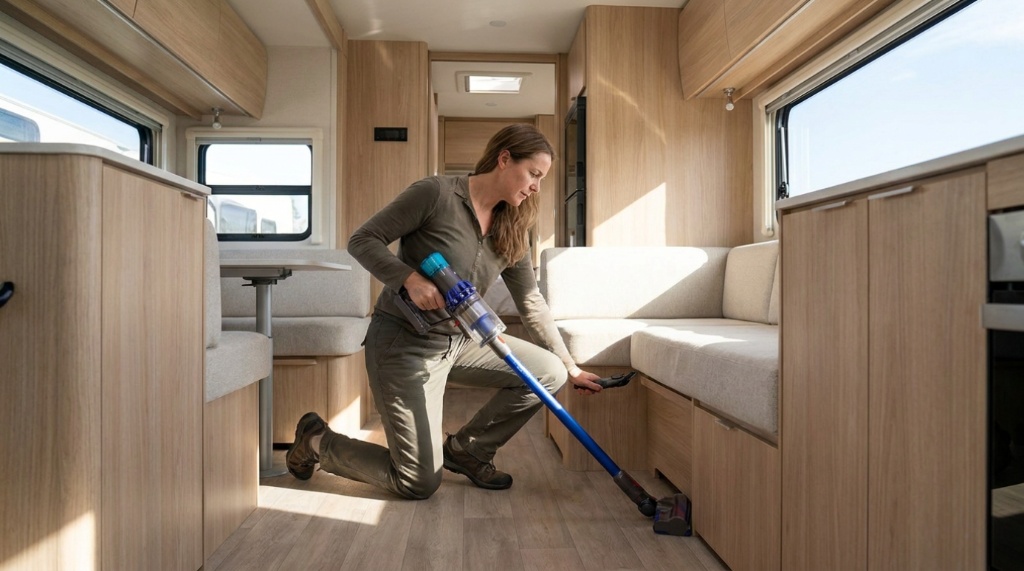
05 Sep What Is the Best Vacuum for RV Cleaning?
Cleaning an RV is a very different challenge than cleaning a house. You’re working with tight spaces, limited power sources, upholstery that sees heavy use, and flooring that transitions from carpet to vinyl to tile. A full-size upright vacuum is too bulky, and a standard cordless stick vacuum often lacks the suction or runtime to get the job done. If you’ve been putting up with crumbs in the crevices or sand on the step well, the right tool can genuinely change how you feel about your space. This guide breaks down the specific types of vacuums that work best on the road, the features that actually matter, and the trade-offs you need to consider before you buy.
Key Takeaways
- The best vacuum for your RV depends on your power setup, storage space, and the types of surfaces you need to clean—not just the price tag.
- Cordless stick vacuums offer the best balance of convenience and storage for most RV owners, but battery life and filter maintenance are critical factors.
- A lightweight canister vacuum is often the smarter choice for RVs with a lot of hard flooring, stairs, or tight corners that a stick vacuum can’t reach.
- If you have pets or frequently camp in sandy areas, prioritize models with strong cyclone separation and washable filters to maintain performance over time.
- Pay attention to how the vacuum stores when not in use; a compact footprint or a mounting bracket matters more in an RV than raw power.
Why an RV Needs a Different Kind of Vacuum
RVs present a unique cleaning environment that most household vacuums simply aren’t designed for. The first issue is storage. Unlike a garage or a closet, an RV has almost no dead space. You need something that slides into a narrow gap, mounts on a wall, or fits inside a small cabinet. The second issue is surface diversity. In a matter of steps, you might clean thick berber carpet in the bedroom, a woven outdoor rug by the door, and rigid vinyl plank in the kitchen. A vacuum that excels on one surface often struggles on another.
How does a vacuum for RV cleaning differ from a standard car vacuum?
While both are compact, a vacuum for RV cleaning requires a broader cleaning path and longer runtime than a typical car vacuum. A car vacuum is designed for spot cleaning floors, seats, and trunk mats, usually with a short hose and a small dust cup. An RV is a mobile home; you need to clean larger continuous areas, high-traffic entryways, and maybe even curtains or window treatments. The battery capacity, the width of the floor nozzle, and the ability to switch between hard floor and carpet mode are all significantly more important in an RV context.
What to Look For in an RV Vacuum: Decision Criteria That Actually Matter
Before you look at any specific model, it helps to establish what parameters are non-negotiable for your situation. Here is a breakdown of the key spec categories you need to evaluate. Ignore marketing gimmicks like “pet turbo brushes” unless you actually have pets, and don’t chase high wattage figures because suction efficiency is more important than raw energy draw.
1. Power Source: Battery vs. 12V vs. 110V
Decide first how you’ll power the vacuum. This will narrow your choices significantly.
- Battery (Cordless): Offers the greatest freedom. You can use it outside the RV to clean the awning or the car. Look for models with lithium-ion batteries that have a runtime of at least 20–30 minutes on standard mode. The main drawback is that you must manage charging time and battery degradation over the years.
- 12V (Car outlet): These are usually smaller, lighter, and cheaper. They never run out of battery as long as your RV battery has charge, but they often lack the suction strength needed for thick carpet. They are best for quick cleanup and hard surfaces.
- 110V (Plug-in): These provide constant, reliable suction. They work well if you always camp with full hookups. Otherwise, you’ll need an inverter, and the cord can be a nuisance in tight quarters.
2. Filtration and Dust Emissions
RV interiors are small, meaning the air quality impact of a vacuum is amplified. A vacuum with poor filtration will blow fine dust back into the air, which then settles on your bedding and counters. Look for the following in the specifications:
- HEPA filters: These are necessary if you have allergies, but you must remember that HEPA filters need to be replaced or washed regularly, depending on the model. A clogged HEPA filter significantly reduces suction.
- Cyclonic separation: This technology spins dirt out of the airstream before it hits the filter. It keeps the filter cleaner longer and maintains consistent suction. It’s a very useful feature for an RV because you are unlikely to empty the bin after every single use.
- Washable filters: Consider how easy the filter is to clean. In an RV, you don’t want to buy expensive replacement cartridges every month. A washable foam or mesh pre-filter is a practical advantage.
3. Physical Footprint and Storage
Measure the storage space you have available. A tall stick vacuum might not fit under a dinette seat. A canister vacuum might fit into a narrow cabinet if the hose detaches. Consider models that come with a wall-mount docking station. This is a huge plus because it keeps the vacuum off the floor and out of the way, allowing you to charge it without taking up useful cabinet space.
Stick Vacuums: The Best All-Rounder for Most RV Owners
If you are looking for one single recommendation that will work well for most people, a cordless stick vacuum is the sweet spot. They offer enough suction for daily maintenance, they are light enough to carry around, and they are narrow enough to fit in a shallow closet. Brands like Shark, Dyson, and even budget-friendly options like Tineco or Hoover have models that convert to a handheld unit, which is extremely useful for cleaning the dashboard, vent covers, or window tracks. The key is to buy a model with a removable battery or a long runtime. If you have both carpet and hard floors, check that the vacuum has a hard-floor setting or a roller that can be turned off. Some stick vacuums have powered brushes that can scatter debris on hard floors; being able to deactivate the brush reduces dust and improves efficiency.
Why suction power isn’t the only factor for a stick vacuum
Many RV owners make the mistake of selecting a stick vacuum with the highest “air watts” they can find. However, with battery powered devices, high suction usually means low runtime. You don’t need 20 minutes of maximum suction to clean an RV; you usually need 10 minutes of moderate suction and a lot of flexibility with the attachments. Also, look at the width of the floor head. A narrow head is easier to maneuver, but a wider head cleans faster. For an RV, a head width of around 9–10 inches is ideal—it’s wide enough to be efficient but narrow enough to navigate around table legs and slide-out edges.
Canister Vacuums: The Underrated Option for Hard Floors and Reaching Tight Spots
Many people overlook a lightweight canister vacuum when shopping for an RV, but it is often the superior choice for a specific type of owner. If your RV is primarily hard flooring (which is common in many newer models that have moved away from residential carpet), a canister vacuum with a hard-floor brush is unbeatably effective. The physical separation between the motor and the nozzle means you can push the small floor head under dinette booths, steps, and even the edge of slide-outs with far less contorting. Additionally, canister vacuums have much longer hoses, which allows you to clean the ceiling AC vents or dust the blinds without dragging the motorized part onto the furniture.
Selecting a compact canister vacuum for an RV
When browsing canister vacuums, look for one that weighs less than 10 pounds and has a telescoping wand. A bagged canister model is often easier to manage than a bagless one on the road, because emptying a bagless bin outside prevents dust clouds inside the RV. Some models have adjustable suction control, which is useful for cleaning delicate curtains or the foam cushions on outdoor furniture. To ensure your device stays reliable throughout your entire road trip without unexpected power loss, learn more about Why Your Cordless Vacuum Battery Dies Fast. The best canister vacuums for RV cleaning have a nice set of onboard tools, including a crevice tool and a dusting brush, so you don’t have to carry an extra accessory bag.
Comparing Types of RVs and Their Cleaning Needs
Type of RV isn’t just a purchase consideration; it directly influences the right vacuum choice. A small teardrop trailer with a two-step entry only needs a handheld vacuum to keep the bedding tidy and the floor crumbs away. A Class A motorhome with a residential-style layout might need a robust stick vacuum or a canister unit to handle a larger square footage without leaving you winded. A fifth-wheel with a loft or stairway creates a need for a long hose and the ability to carry the vacuum up a ladder.
The table below outlines how your RV type should inform your vacuum selection.
| RV Type | Typical Flooring | Cleaning Needs | Recommended Vacuum Style |
|---|---|---|---|
| Class B Camper Van | Mostly hard floors / vinyl with removable carpets | Very tight spaces, minimal storage | Handheld or cordless stick with a compact footprint |
| Class C Motorhome | Carpet over cab, hard floors in living/kitchen | Overhead surfaces and floor transitions | Stick vacuum with a dedicated hard floor mode |
| Travel Trailer (Cab-over bed) | Stair-free, mix of carpet and vinyl | Quick daily cleanups and under-table access | Canister vacuum for reach or a light stick vacuum |
| Fifth-Wheel (with stairs/loft) | Residential carpet and tile in main living | Steps need cleaning; higher ceilings | Canister vacuum with a long hose or a corded stick vacuum |
Common Mistakes to Avoid When Buying an RV Vacuum
After identifying your power source and form factor, many buyers still end up with a tool that frustrates them. Here are the top mistakes to avoid.
Overlooking the “auto-shutoff” on hard floors
If your RV has any vinyl or laminate flooring, a vacuum with a powered brush roll that doesn’t have a shutoff will occasionally sling small debris out from under the edges. Worse, it can scratch dark floors over time. Check that the model includes a brush roll shutoff switch or a sensor that adjusts height automatically.
Ignoring the weight of the vacuum on your upper body
A heavy stick vacuum with a floor head at the end of a long wand can be cumbersome to balance. Try to keep the total weight to under 8 pounds—less if you have physical limitations.
Choosing a vacuum without a hose
Some compact stick vacuums are strictly “stick-only” and the handheld attachment requires removing the main shaft. In an RV, you need a flexible hose to get under appliances and behind the refrigerator vent. Even a short hose section makes a world of difference for versatility.
Frequently Asked Questions
Can I use a regular home stick vacuum in an RV?
Yes, you can use a regular stick vacuum if it has a manageable footprint and adequate battery life. But beware of weight and storage dimensions; many vertical units are too tall to fit in RV cabinets. You should also ensure the vacuum handles hard floors well and doesn’t require a large docking station.
Are bagless vacuums or bagged vacuums better for RV cleaning?
Bagless vacuums are generally more popular because you don’t need to remember to buy a specific bag when you are on the road—you can just empty the bin into a trash can before you leave a campsite. Bagged vacuums are better if you have strong allergies, as the bags trap dust more effectively and the bin never needs washing.
Is a 12V vacuum poweful enough for RV carpet?
Not usually. Most 12V car-style vacuums generate suction that is fine for hard floors and car seating, but they will not deep-clean carpet fibers or pull out embedded sand. For any carpeted area in an RV, choose a cordless stick or a 110V canister instead.
How often should I clean the vacuum filter?
You should clean the washable foam filter at least once a month if you clean the RV weekly. HEPA filters should be washed once every three months or replaced if they show discoloration. If you camp in very dusty or sandy environments, increase the frequency of cleaning to maintain suction power.
Should I buy a separate handheld vacuum for the RV?
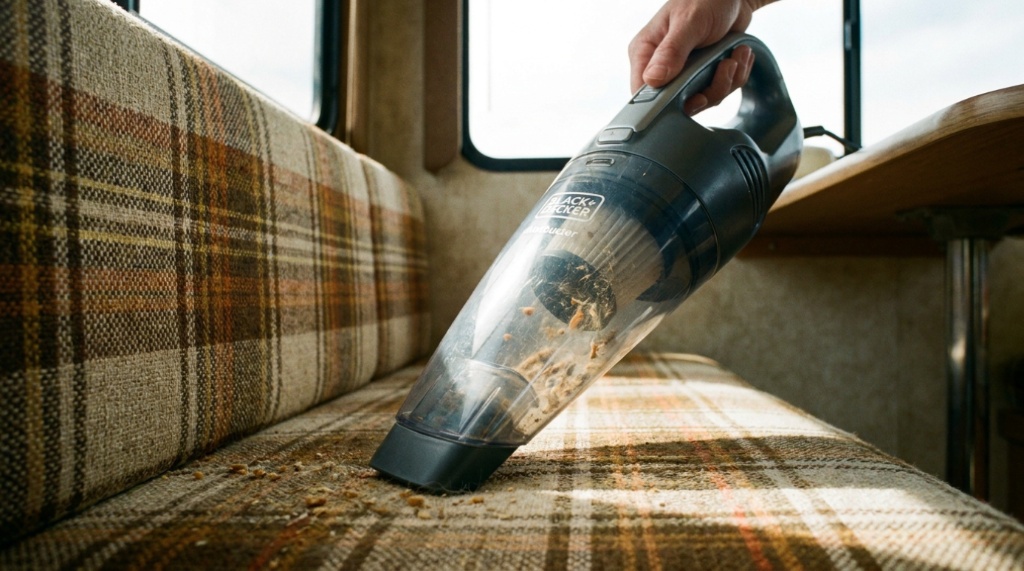
If your main vacuum is a canister model, you might not need a separate handheld because you can just use the hose and crevasse tool. But if you have a bulky stick vacuum with limited accessories, a small handheld lithium-ion unit is perfect for quick cleanups, dusting the dash, and vacuuming under the dinette after each meal.
Conclusion
Selecting the best vacuum for RV cleaning comes down to understanding the physical realities of your rig and your personal cleaning habits. It’s less about finding the highest-spec model and more about finding the right fit for your storage, power, and floor types. For most RV owners, a mid-weight cordless stick vacuum with excellent attachment storage and washable filters is the most practical daily tool. If you have predominantly hard flooring and struggle with awkward angles, a lightweight canister vacuum will serve you better.
No Comments